
Is Manufacturing a Safe Career? What a Modern Machine Shop Should Look Like
Dark. Dirty. Dangerous.
That’s the machine shop most people still picture when they imagine a career in manufacturing. A dim cavern of exposed gears and flying sparks pulled straight from an old movie or a grandparent’s story. It’s a vivid image, and it’s doing real damage. It’s also decades out of date.
That gap between the inherited image and the modern reality matters, because it’s quietly steering people away from one of the better career bets available right now. For students, the parents guiding them and machinists who don’t have to stay stuck in a shop built around the past, the floor you’re imagining barely exists anymore.
What actually keeps people safe on a modern floor tells a very different story.
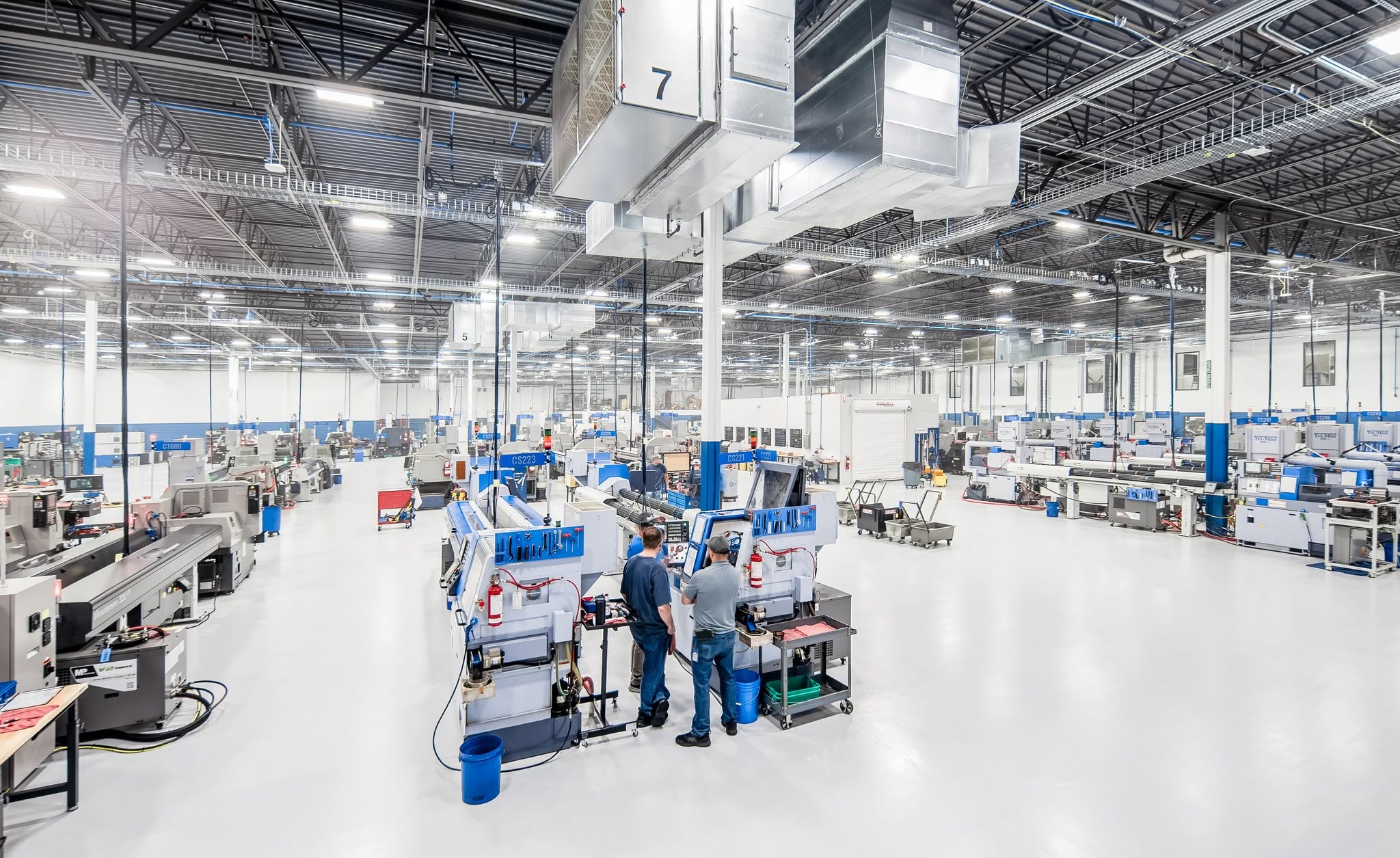
What actually changed on the shop floor
The old stereotype wasn’t invented out of nothing. Mid-century manufacturing genuinely was loud, hot and full of hazards that today would never pass a walkthrough. Those who’re nervous about the trades aren’t being unreasonable. They’re just working from old information.
The physical floor has been re-engineered around a simple idea: keep the operator out of the line of fire in the first place. Modern CNC and Swiss machines often run inside fully enclosed cells, so the actual machining happens behind a barrier, not in open air. Machine guarding and interlocks stop a process the instant a door opens. Coolant and air handling systems manage the mist, chips and fine particulate that older shops just lived with. Material handling has been redesigned around ergonomics, so people aren’t wrecking their backs moving stock. Lighting, layout and climate control have all moved from afterthoughts to design requirements.
None of this is one shop’s marketing. The broader trend shows up in the national numbers. In 2024, the total recordable injury and illness rate across private industry fell to 2.3 cases per 100 full-time workers, the lowest in the more than two decades the Bureau of Labor Statistics has tracked it, and manufacturing was again one of the sectors that improved.
“The floor didn’t get safer by accident. It got safer because the industry decided that protecting people and running an efficient operation are the same project” says Marc Douglas, Director of Facilities, Maintenance & Reliability. “Modern manufacturing is no longer built around exposing people to hazards and managing the consequences. It’s built around engineering hazards out of the process whenever possible through automation, guarding, ergonomics and disciplined safety systems.”
Training is the real safety system
Here’s the part that matters most if you’re the one starting out: the equipment is only half of it. The other half, the more important half, is how people are taught.
A guarded machine doesn’t make a shop safe on its own. What makes it safe is a culture where new people are brought up deliberately, where supervision is real and where stopping to fix a problem is rewarded instead of being treated as slowing things down. The shops that get this right don’t hand someone a machine and hope for the best. They build judgment, because a machinist who understands why a habit exists makes better decisions for the next thirty years than one who just memorized the rule.
What a good first 90 days looks like
If you’ve never worked in a shop, the unknown is the scary part, so it’s worth knowing what a well-run start actually feels like. You should not be running a machine alone on day one. Early on, you’re learning the floor, shadowing experienced operators and being taught the reasoning behind each safety practice, not just the practice itself. Supervision is close at the start and loosens as you demonstrate you’ve earned it. Questions are expected, not penalized. A shop that rushes you onto production unsupervised is telling you something, and it isn’t good.
“No one walks onto our floor and gets handed a machine on day one” says Barry Butters, Director of Education & Outreach. “We teach the why behind every safety habit, not just the rule, because a machinist who understands the risk makes better decisions for the next thirty years. That’s the difference between training someone and just onboarding them.”
Why a safe shop is usually a well-run shop
National data proves the floor got safer on average. But averages hide a real gap between shops doing the bare minimum and shops that build safety into how they operate. That gap is worth understanding, because it tells you something about a company well beyond its safety record.
Reader Precision Solutions is one of the shops that lands on the right side of that gap, and there’s a useful piece of outside evidence for it. RPS hosts students through partnerships with the Milwaukee School of Engineering, UW-Platteville, Gateway Technical College, Career and College Academy, Elkhorn Area High School, Delavan-Darien High School, Whitewater High School, Lake Geneva Badger High School, East Troy High School, Williams Bay Highschool and Big Foot High School.
That kind of relationship is telling, because educational institutions don’t send their students just anywhere. A shop has to be a credible, well-run training environment to be trusted with people who are still learning. Safety isn’t the only reason those partnerships exist, but a floor that’s safe and organized enough to teach on is part of what makes a shop fit to host students at all.
What to look for when you’re choosing where to start
When you’re evaluating a place to begin a machining career, ask real questions.
- Ask whether the machines are guarded and enclosed. Ask how training actually works in the first few months, and who’s responsible for it.
- Ask about the safety record, and notice whether they answer plainly or get defensive.
- And just look around: an organized, well-lit, clearly laid-out floor is usually a sign of a shop that has its act together everywhere else too. A workplace that takes your safety seriously is almost always one that takes the rest of the job seriously.
The trades are being rebuilt right now by a generation that simply expects to work somewhere that takes their safety seriously, and that expectation is making the whole industry better. The dangerous-factory image belongs in the old movies it came from. The real modern floor is engineered, monitored and built around the people on it, which makes machining not just a safe career, but a smart one for anyone willing to learn the craft.
If you want to see what a modern floor actually looks like, or explore where an apprenticeship could take you, take a look at readerprecision.com/careers/. The work is more advanced, more in demand and a great deal safer than the stigma in your head.